Let's startwith a quick test. No calculators, no ChatGPT, no asking the colleague next to you.
A bat and a ball cost €1.10 in total. The bat costs €1.00 more than the ball. How much does the ball cost?
10 cents? Of course. Obvious. Next question.
Except it isn't. The ball costs 5 cents. Do the maths again; we'll wait.
Still 5.
If it helps, Nobel laureate Daniel Kahneman reported that more than half of studentsat Harvard, MIT and Princeton fell for it too. So congratulations: you're officially in elite company. You're also officially human.
We like to call ourselves data-driven. We have dashboards for everything, KPIs for our KPIs, and an opinion on every chart. Yet the algorithm we use most is the one between our ears, and nobody has ever code-reviewed it.
Kahneman described two modes of thinking:
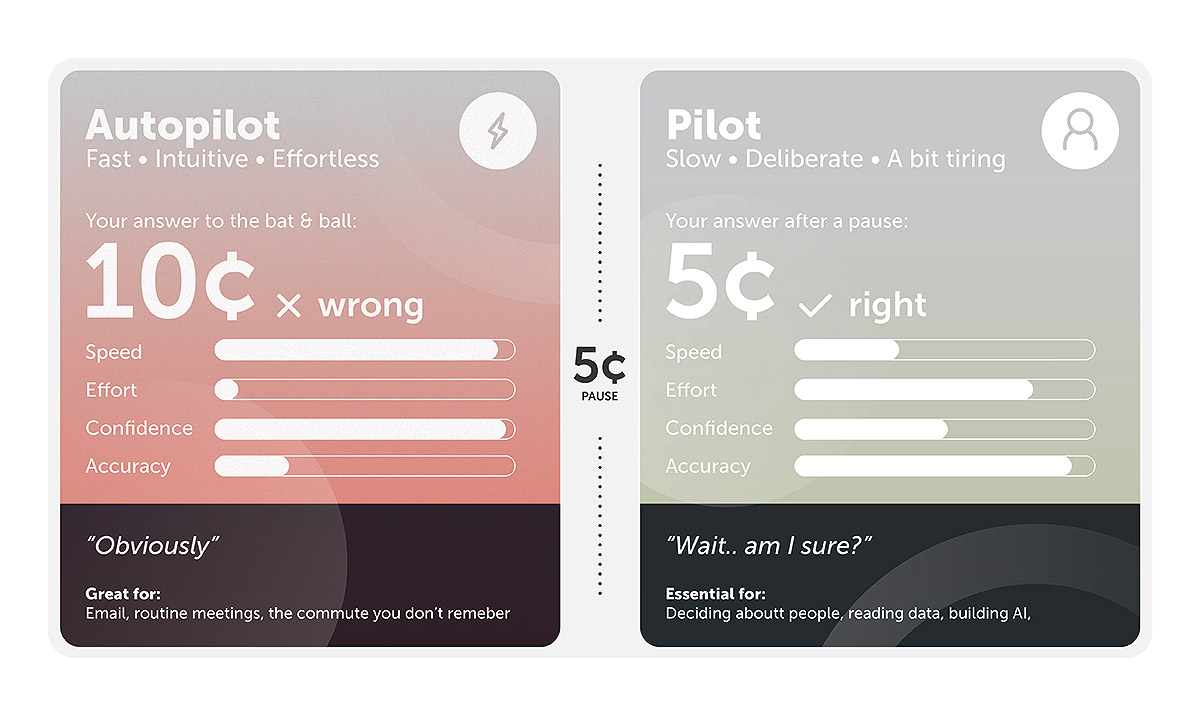
Autopilot runs most of the flight, and that's fine.
But real pilots know something we tend to forget: you take control at take-off and landing. Those are the moments that matter.
The problem is that our autopilot doesn't announce itself. It doesn't say "I'm guessing here." It just hands us an answer that feels right, wrapped in the warm confidence of "people like me", "we've always done it this way" and "obviously".
That's where bias lives. It doesn't come from bad people with bad intentions. It comes from good people on autopilot at the wrong moment.
Try a simple exercise. Think about last week and spot the moments where autopilot was flying and a pilot should have been in the seat:
In an edition dedicated to insights, here's an unglamorous truth: the best insight is rarely the first answer. It's usually the second one, the one that shows after we stop and ask "Wait… am I sure?"
That pause costs about 5 cents. Funny how it's always the most expensive thing to skip.
So, next time something feels obvious, who will be flying: you, or your autopilot?
"We can be blind to the obvious, and we are also blind to our blindness." — Daniel Kahneman
Ready to take control? Join the next edition of Preventing Unconscious Bias and Building an Inclusive Workplace and find out how often your autopilot has been flying without you noticing. Sign up here.
Let's startwith a quick test. No calculators, no ChatGPT, no asking the colleague next to you.
A bat and a ball cost €1.10 in total. The bat costs €1.00 more than the ball. How much does the ball cost?
10 cents? Of course. Obvious. Next question.
Except it isn't. The ball costs 5 cents. Do the maths again; we'll wait.
Still 5.
If it helps, Nobel laureate Daniel Kahneman reported that more than half of studentsat Harvard, MIT and Princeton fell for it too. So congratulations: you're officially in elite company. You're also officially human.
We like to call ourselves data-driven. We have dashboards for everything, KPIs for our KPIs, and an opinion on every chart. Yet the algorithm we use most is the one between our ears, and nobody has ever code-reviewed it.
Kahneman described two modes of thinking:

Autopilot runs most of the flight, and that's fine.
But real pilots know something we tend to forget: you take control at take-off and landing. Those are the moments that matter.
The problem is that our autopilot doesn't announce itself. It doesn't say "I'm guessing here." It just hands us an answer that feels right, wrapped in the warm confidence of "people like me", "we've always done it this way" and "obviously".
That's where bias lives. It doesn't come from bad people with bad intentions. It comes from good people on autopilot at the wrong moment.
Try a simple exercise. Think about last week and spot the moments where autopilot was flying and a pilot should have been in the seat:
In an edition dedicated to insights, here's an unglamorous truth: the best insight is rarely the first answer. It's usually the second one, the one that shows after we stop and ask "Wait… am I sure?"
That pause costs about 5 cents. Funny how it's always the most expensive thing to skip.
So, next time something feels obvious, who will be flying: you, or your autopilot?
"We can be blind to the obvious, and we are also blind to our blindness." — Daniel Kahneman
Ready to take control? Join the next edition of Preventing Unconscious Bias and Building an Inclusive Workplace and find out how often your autopilot has been flying without you noticing. Sign up here.