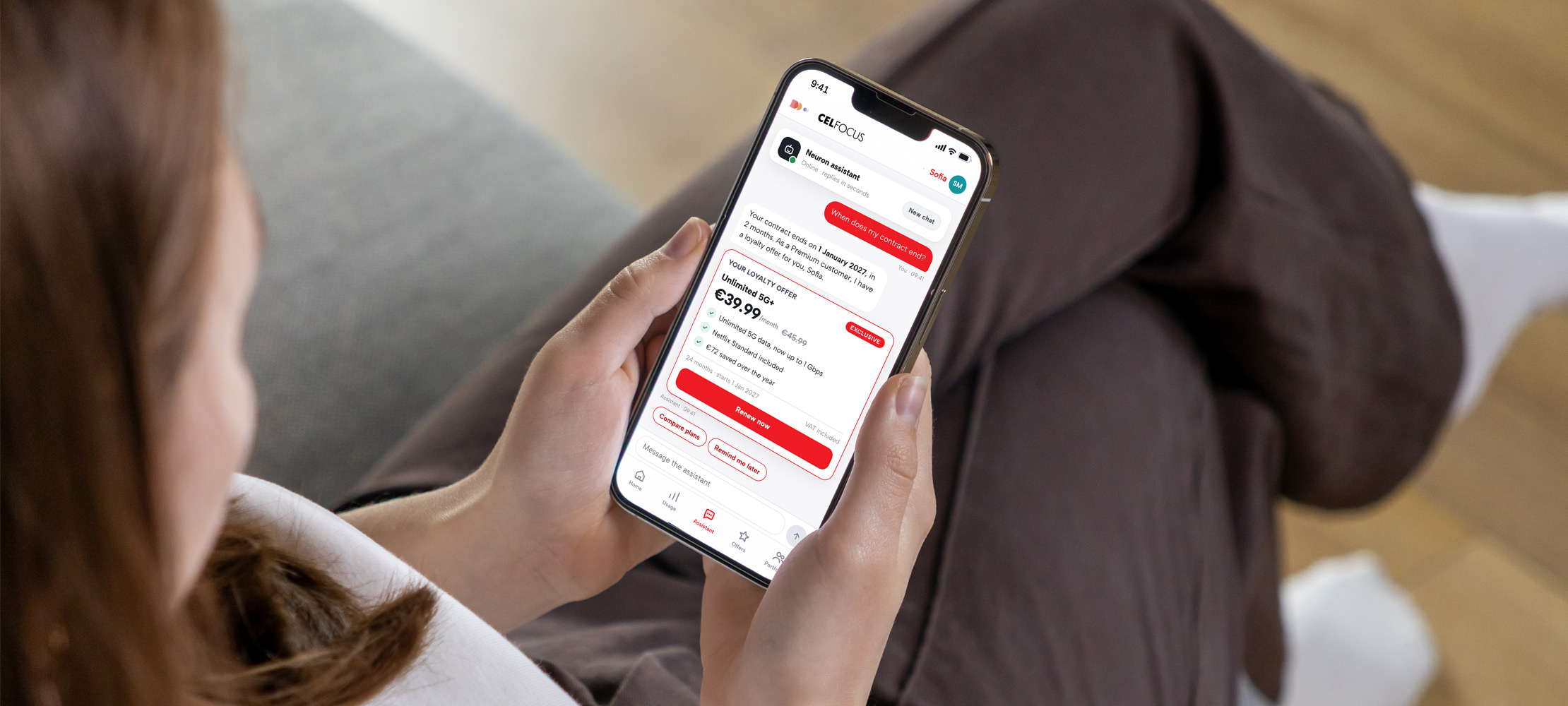
Increasingly, customers turn to AI assistants for help before opening an app or calling their operator. They want to compare offers, change a tariff or understand a bill. Gartner expects 70% of customer service journeys to begin and be resolved through AI assistants built into mobile devices by 2028.
Operators’ own self-service channels are not keeping up. Only 14% of journeys are fully resolved through self-service, even though three in four customers try these channels first. In just one year, the use of third-party AI assistants for customer service has roughly doubled, while usage of operators’ own chatbots has remained flat since 2022.
Today, most AI assistants cannot connect directly to an operator’s systems. They can only provide information available on the operator’s public website, which may be outdated, and they cannot complete the request. Customers are then sent back to the app, a shop or the call centre.
ACX, Agentic Customer eXperience, is Celfocus answer to this gap. It enables AI assistants, both the operator’s own, such as Vodafone TOBi, and those customers already use, such as Gemini or Claude, to carry out real requests within the operator’s systems: check a bill, change a tariff, replace a SIM or buy a new line. The assistant carries out the request, while the operator’s rules determine what it is allowed to do.
ACX does not add a new technology stack or duplicate existing business rules. It builds on the operator’s existing digital stack, reusing the services that already support channels such as the app, web, shops and call centre, and extending them to a new channel: AI assistants.
Over the past few months, the team has built a working prototype that can be demonstrated and tested with customers and internal teams. Between the AI assistant and the operator’s systems sit three layers:
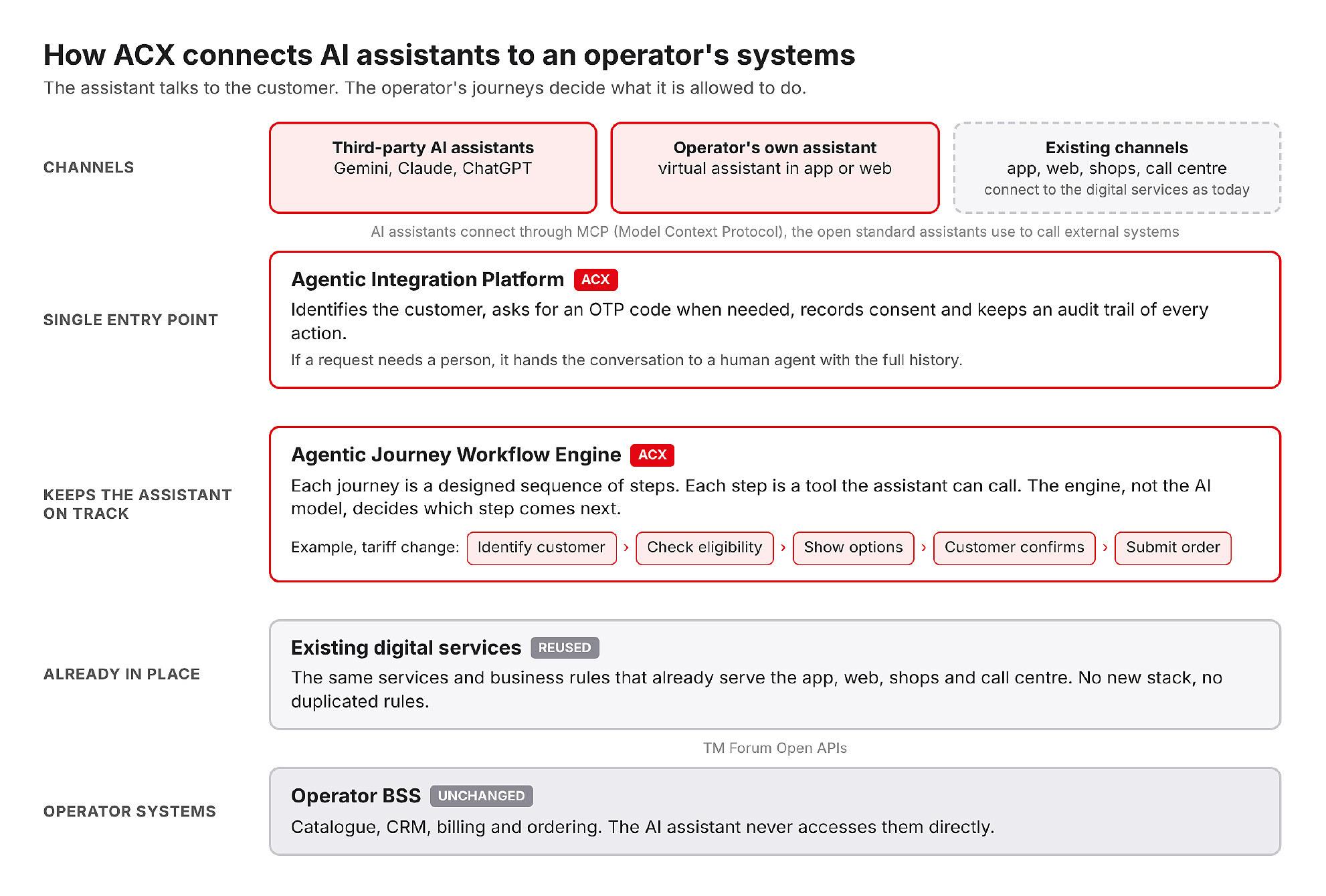
The prototype runs on Celfocus premises over a simulated BSS, with no client code or data. Today it covers journeys such as looking up a bill, comparing and recommending offers, changing a tariff, buying a new line with delivery, replacing a SIM and opening a support ticket.
ACX was built by a small team combining architecture and engineering:
Next, we will take the prototype to customers. We are planning customer demos to validate the solution against real operator needs, find out which journeys matter most to them, and learn what they need to see before they let AI assistants serve their own customers. Their feedback will decide which journeys we build next and how we prepare security and governance for production.
If you would like to see ACX in action, or you have a client conversation where it could fit, talk to the team.
Increasingly, customers turn to AI assistants for help before opening an app or calling their operator. They want to compare offers, change a tariff or understand a bill. Gartner expects 70% of customer service journeys to begin and be resolved through AI assistants built into mobile devices by 2028.
Operators’ own self-service channels are not keeping up. Only 14% of journeys are fully resolved through self-service, even though three in four customers try these channels first. In just one year, the use of third-party AI assistants for customer service has roughly doubled, while usage of operators’ own chatbots has remained flat since 2022.
Today, most AI assistants cannot connect directly to an operator’s systems. They can only provide information available on the operator’s public website, which may be outdated, and they cannot complete the request. Customers are then sent back to the app, a shop or the call centre.
ACX, Agentic Customer eXperience, is Celfocus answer to this gap. It enables AI assistants, both the operator’s own, such as Vodafone TOBi, and those customers already use, such as Gemini or Claude, to carry out real requests within the operator’s systems: check a bill, change a tariff, replace a SIM or buy a new line. The assistant carries out the request, while the operator’s rules determine what it is allowed to do.
ACX was built by a small team combining architecture and engineering:
Increasingly, customers turn to AI assistants for help before opening an app or calling their operator. They want to compare offers, change a tariff or understand a bill. Gartner expects 70% of customer service journeys to begin and be resolved through AI assistants built into mobile devices by 2028.
Operators’ own self-service channels are not keeping up. Only 14% of journeys are fully resolved through self-service, even though three in four customers try these channels first. In just one year, the use of third-party AI assistants for customer service has roughly doubled, while usage of operators’ own chatbots has remained flat since 2022.
Today, most AI assistants cannot connect directly to an operator’s systems. They can only provide information available on the operator’s public website, which may be outdated, and they cannot complete the request. Customers are then sent back to the app, a shop or the call centre.
ACX, Agentic Customer eXperience, is Celfocus answer to this gap. It enables AI assistants, both the operator’s own, such as Vodafone TOBi, and those customers already use, such as Gemini or Claude, to carry out real requests within the operator’s systems: check a bill, change a tariff, replace a SIM or buy a new line. The assistant carries out the request, while the operator’s rules determine what it is allowed to do.
ACX does not add a new technology stack or duplicate existing business rules. It builds on the operator’s existing digital stack, reusing the services that already support channels such as the app, web, shops and call centre, and extending them to a new channel: AI assistants.
Over the past few months, the team has built a working prototype that can be demonstrated and tested with customers and internal teams. Between the AI assistant and the operator’s systems sit three layers:

The prototype runs on Celfocus premises over a simulated BSS, with no client code or data. Today it covers journeys such as looking up a bill, comparing and recommending offers, changing a tariff, buying a new line with delivery, replacing a SIM and opening a support ticket.
ACX was built by a small team combining architecture and engineering:
Next, we will take the prototype to customers. We are planning customer demos to validate the solution against real operator needs, find out which journeys matter most to them, and learn what they need to see before they let AI assistants serve their own customers. Their feedback will decide which journeys we build next and how we prepare security and governance for production.
If you would like to see ACX in action, or you have a client conversation where it could fit, talk to the team.