More
CALL to Authenticity

Digital transformation has entered a new phase. For software engineers and front‑end developers, AI is no longer an experimental productivity tool. It is increasingly embedded in how software is designed, built, tested, and maintained. From code generation to architectural decision‑making, AI capabilities are reshaping engineering practices at unprecedented speed.
In the past, engineering value was often measured by output volume, i.e. lines of code written, features delivered, or tickets completed. In an AI-enabled development environment, this changes significantly. Code generation becomes increasingly assisted, which means the differentiation is no longer in typing speed or conventional implementation. Instead, value shifts toward problem framing, system design, validation, and architectural decision-making.
Engineers are now expected to operate at a higher abstraction level. Rather than focusing on “how to implement every detail,” they increasingly focus on “what should be built and why it should exist in the system.” AI tools act as accelerators for implementation, but humans remain responsible for correctness, scalability, maintainability, and alignment with business intent.
Modern engineering organizations require software engineers and front-end teams to continuously evolve beyond traditional coding practices. Training is no longer limited to mastering programming languages or frameworks; it now includes understanding how to collaborate effectively with AI copilots, automation platforms, and intelligent development tools.
As these shifts redefine engineering excellence, organizations must ensure their teams are equipped to work effectively in AI‑augmented environments.
As engineering practices evolve, continuous learning becomes a strategic necessity. Organizations that invest in AI upskilling enable their teams to adopt new ways of working faster, while maintaining quality, security, and engineering excellence.
Modern engineering teams increasingly work in shorter experimentation cycles, using AI to prototype, test, document, and troubleshoot faster than before. Ultimately, companies that prioritize AI literacy across software engineering and front-end functions will be better positioned to scale innovation, improve employee productivity, and create more intuitive and intelligent digital experiences.
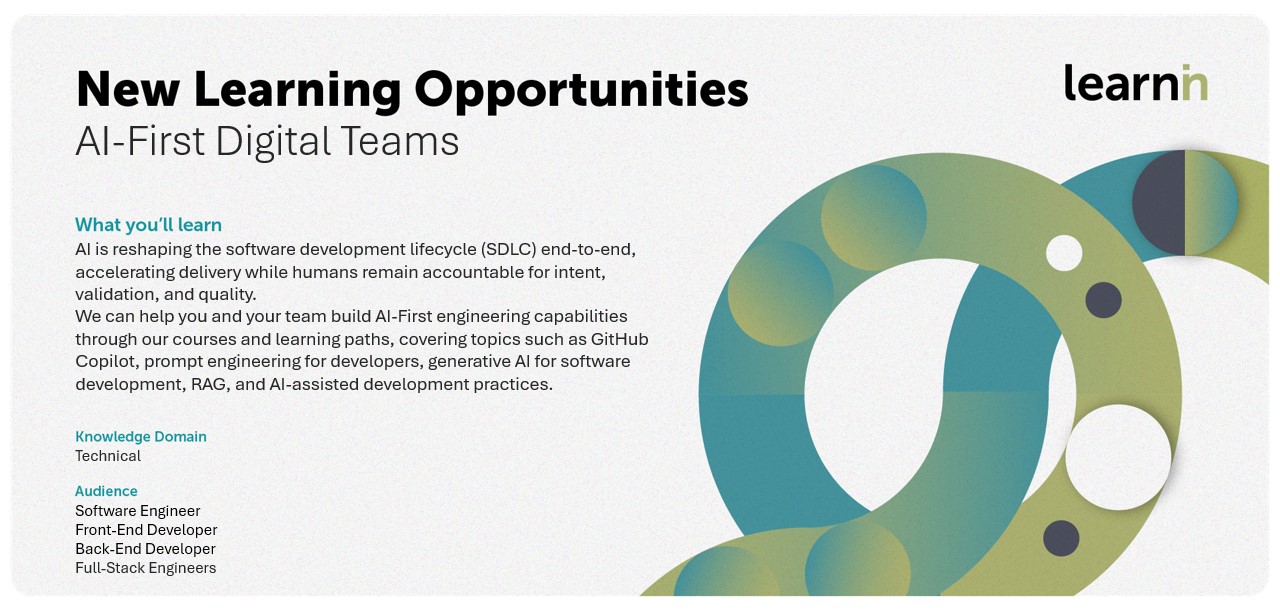
As part of our commitment to AI-powered engineering, Celfocus offers training programs covering topics such as GitHub Copilot, prompt engineering for developers, generative AI for software development, RAG, AI-assisted development practices and much more.
A. The Software Engineer, as we knew them, probably won’t disappear - but the daily focus and the skills that matter most will change significantly.
If we narrow it to the coding part of the job, the work stops being writing code line by line and becomes more about framing the problem, writing specifications that an agent can actually execute, and reviewing the output with enough context to spot when it's confidently wrong.
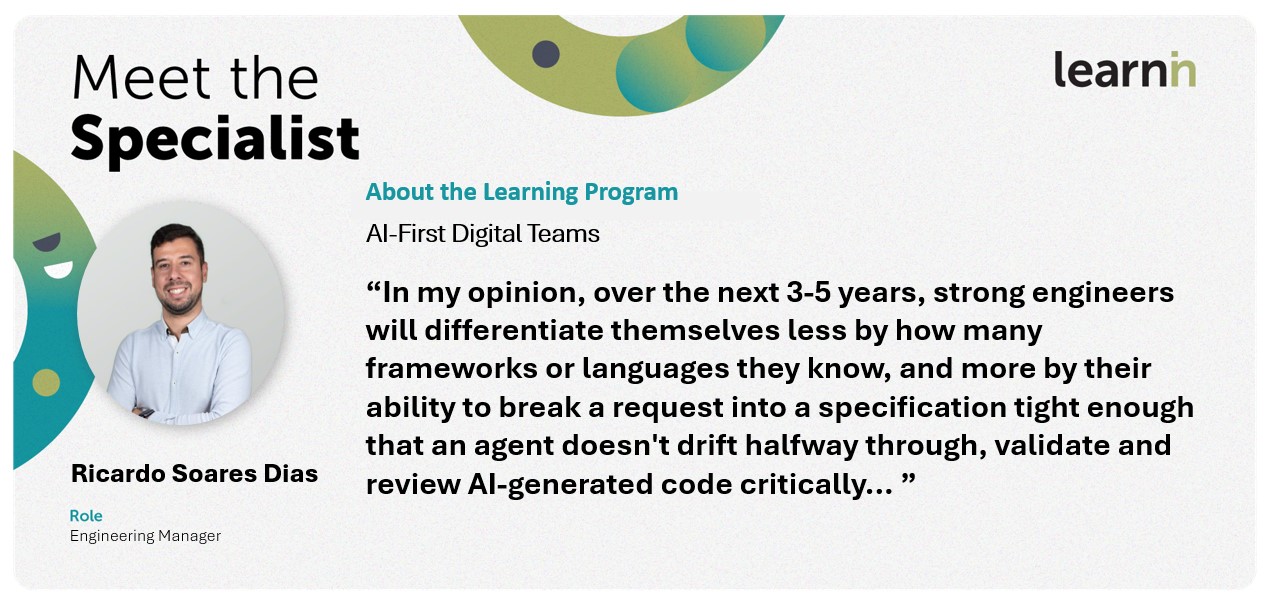
In my opinion, over the next 3-5 years, strong engineers will differentiate themselves less by how many frameworks or languages they know, and more by their ability to break a request into a specification tight enough that an agent doesn't drift halfway through, validate and review AI-generated code critically, and understand the system end-to-end so they catch the integration failures the agent has no way to see (example: business context).
Knowing when to stop prompting and just write the thing themselves matters too, probably more than people admit.
A. The author of the pull request or commit is the owner, whether the code was written manually or generated by an AI agent. If that principle disappears, accountability disappears with it.
“The AI wrote it” or "Copilot/Claude told me" cannot become an acceptable excuse for bugs, security issues, or poor design decisions. Using AI is still a human decision, and the responsibility stays with the engineer who approved and shipped the change.
For that to work in practice, teams need review processes that treat AI-generated code with the same mindset as reviewing a junior engineer’s first pull request. Not as “the tests passed, so it’s probably fine.”
The real risk isn't that AI-generated code is bad because Software Engineers can also produce bad code. The bigger risk is that teams stop reading carefully because the output looks polished and arrives quickly. That’s how you end up with fast pull requests, accumulating complexity, and codebases full of logic that nobody truly understands or feels confident modifying.
A. This is the question I think about the most, because the trap is real: teams can ship faster for some months and then suddenly realise nobody can properly debug or maintain the system anymore.
What works for me is keeping the human actively in the loop. Read what the agent produced, not just the summary. If you can't explain what the code does and why it chose that approach, you don't own it yet, even if it works.
For Junior Software Engineers, I'd go further. I strongly recommend running sessions where they walk through what the AI generated and explain it back, line by line if needed. Not as a code review, but as a learning exercise. The risk with juniors isn't that they'll deliver bad code, it's that they'll deliver good code without understanding why it's good, and three years later, they still won't know.
More broadly, AI should be an accelerator, not a replacement for engineering understanding.
The role of engineers is shifting from manual implementation to system orchestration. AI accelerates coding, testing, and debugging, but human engineers remain responsible for architecture, judgment, and long-term system integrity.
In this new era, AI literacy becomes a baseline skill, and continuous learning becomes part of the job. AI-powered engineering teams are not defined by how much AI they use, but by how deeply AI is integrated into how they think, design, and build systems. The organizations that succeed in this transition will be those that treat AI not as a productivity tool, but as a fundamental shift in how software is engineered.
Celfocus will continue to promote AI-First courses and certifications, enabling Digital teams to develop the capabilities required for the next generation of software engineering. To learn more about the AI & Digital training offer, please explore our catalogue here or contact us at training@celfocus.com.
This article is brought to you by Esmeralda Monteiro, Celfocus Training Manager.
Digital transformation has entered a new phase. For software engineers and front‑end developers, AI is no longer an experimental productivity tool. It is increasingly embedded in how software is designed, built, tested, and maintained. From code generation to architectural decision‑making, AI capabilities are reshaping engineering practices at unprecedented speed.
In the past, engineering value was often measured by output volume, i.e. lines of code written, features delivered, or tickets completed. In an AI-enabled development environment, this changes significantly. Code generation becomes increasingly assisted, which means the differentiation is no longer in typing speed or conventional implementation. Instead, value shifts toward problem framing, system design, validation, and architectural decision-making.
Engineers are now expected to operate at a higher abstraction level. Rather than focusing on “how to implement every detail,” they increasingly focus on “what should be built and why it should exist in the system.” AI tools act as accelerators for implementation, but humans remain responsible for correctness, scalability, maintainability, and alignment with business intent.
Modern engineering organizations require software engineers and front-end teams to continuously evolve beyond traditional coding practices. Training is no longer limited to mastering programming languages or frameworks; it now includes understanding how to collaborate effectively with AI copilots, automation platforms, and intelligent development tools.
As these shifts redefine engineering excellence, organizations must ensure their teams are equipped to work effectively in AI‑augmented environments.
As engineering practices evolve, continuous learning becomes a strategic necessity. Organizations that invest in AI upskilling enable their teams to adopt new ways of working faster, while maintaining quality, security, and engineering excellence.
Modern engineering teams increasingly work in shorter experimentation cycles, using AI to prototype, test, document, and troubleshoot faster than before. Ultimately, companies that prioritize AI literacy across software engineering and front-end functions will be better positioned to scale innovation, improve employee productivity, and create more intuitive and intelligent digital experiences.
As part of our commitment to AI-powered engineering, Celfocus offers training programs covering topics such as GitHub Copilot, prompt engineering for developers, generative AI for software development, RAG, AI-assisted development practices and much more.
A. The Software Engineer, as we knew them, probably won’t disappear - but the daily focus and the skills that matter most will change significantly.
If we narrow it to the coding part of the job, the work stops being writing code line by line and becomes more about framing the problem, writing specifications that an agent can actually execute, and reviewing the output with enough context to spot when it's confidently wrong.
In my opinion, over the next 3-5 years, strong engineers will differentiate themselves less by how many frameworks or languages they know, and more by their ability to break a request into a specification tight enough that an agent doesn't drift halfway through, validate and review AI-generated code critically, and understand the system end-to-end so they catch the integration failures the agent has no way to see (example: business context).
Knowing when to stop prompting and just write the thing themselves matters too, probably more than people admit.
A. The author of the pull request or commit is the owner, whether the code was written manually or generated by an AI agent. If that principle disappears, accountability disappears with it.
“The AI wrote it” or "Copilot/Claude told me" cannot become an acceptable excuse for bugs, security issues, or poor design decisions. Using AI is still a human decision, and the responsibility stays with the engineer who approved and shipped the change.
For that to work in practice, teams need review processes that treat AI-generated code with the same mindset as reviewing a junior engineer’s first pull request. Not as “the tests passed, so it’s probably fine.”
The real risk isn't that AI-generated code is bad because Software Engineers can also produce bad code. The bigger risk is that teams stop reading carefully because the output looks polished and arrives quickly. That’s how you end up with fast pull requests, accumulating complexity, and codebases full of logic that nobody truly understands or feels confident modifying.
A. This is the question I think about the most, because the trap is real: teams can ship faster for some months and then suddenly realise nobody can properly debug or maintain the system anymore.
What works for me is keeping the human actively in the loop. Read what the agent produced, not just the summary. If you can't explain what the code does and why it chose that approach, you don't own it yet, even if it works.
For Junior Software Engineers, I'd go further. I strongly recommend running sessions where they walk through what the AI generated and explain it back, line by line if needed. Not as a code review, but as a learning exercise. The risk with juniors isn't that they'll deliver bad code, it's that they'll deliver good code without understanding why it's good, and three years later, they still won't know.
More broadly, AI should be an accelerator, not a replacement for engineering understanding.
The role of engineers is shifting from manual implementation to system orchestration. AI accelerates coding, testing, and debugging, but human engineers remain responsible for architecture, judgment, and long-term system integrity.
In this new era, AI literacy becomes a baseline skill, and continuous learning becomes part of the job. AI-powered engineering teams are not defined by how much AI they use, but by how deeply AI is integrated into how they think, design, and build systems. The organizations that succeed in this transition will be those that treat AI not as a productivity tool, but as a fundamental shift in how software is engineered.
Celfocus will continue to promote AI-First courses and certifications, enabling Digital teams to develop the capabilities required for the next generation of software engineering. To learn more about the AI & Digital training offer, please explore our catalogue here or contact us at training@celfocus.com.
This article is brought to you by Esmeralda Monteiro, Celfocus Training Manager.
Digital transformation has entered a new phase. For software engineers and front‑end developers, AI is no longer an experimental productivity tool. It is increasingly embedded in how software is designed, built, tested, and maintained. From code generation to architectural decision‑making, AI capabilities are reshaping engineering practices at unprecedented speed.
In the past, engineering value was often measured by output volume, i.e. lines of code written, features delivered, or tickets completed. In an AI-enabled development environment, this changes significantly. Code generation becomes increasingly assisted, which means the differentiation is no longer in typing speed or conventional implementation. Instead, value shifts toward problem framing, system design, validation, and architectural decision-making.
Engineers are now expected to operate at a higher abstraction level. Rather than focusing on “how to implement every detail,” they increasingly focus on “what should be built and why it should exist in the system.” AI tools act as accelerators for implementation, but humans remain responsible for correctness, scalability, maintainability, and alignment with business intent.
Modern engineering organizations require software engineers and front-end teams to continuously evolve beyond traditional coding practices. Training is no longer limited to mastering programming languages or frameworks; it now includes understanding how to collaborate effectively with AI copilots, automation platforms, and intelligent development tools.
As these shifts redefine engineering excellence, organizations must ensure their teams are equipped to work effectively in AI‑augmented environments.
As engineering practices evolve, continuous learning becomes a strategic necessity. Organizations that invest in AI upskilling enable their teams to adopt new ways of working faster, while maintaining quality, security, and engineering excellence.
Modern engineering teams increasingly work in shorter experimentation cycles, using AI to prototype, test, document, and troubleshoot faster than before. Ultimately, companies that prioritize AI literacy across software engineering and front-end functions will be better positioned to scale innovation, improve employee productivity, and create more intuitive and intelligent digital experiences.
As part of our commitment to AI-powered engineering, Celfocus offers training programs covering topics such as GitHub Copilot, prompt engineering for developers, generative AI for software development, RAG, AI-assisted development practices and much more.
A. The Software Engineer, as we knew them, probably won’t disappear - but the daily focus and the skills that matter most will change significantly.
If we narrow it to the coding part of the job, the work stops being writing code line by line and becomes more about framing the problem, writing specifications that an agent can actually execute, and reviewing the output with enough context to spot when it's confidently wrong.
In my opinion, over the next 3-5 years, strong engineers will differentiate themselves less by how many frameworks or languages they know, and more by their ability to break a request into a specification tight enough that an agent doesn't drift halfway through, validate and review AI-generated code critically, and understand the system end-to-end so they catch the integration failures the agent has no way to see (example: business context).
Knowing when to stop prompting and just write the thing themselves matters too, probably more than people admit.
A. The author of the pull request or commit is the owner, whether the code was written manually or generated by an AI agent. If that principle disappears, accountability disappears with it.
“The AI wrote it” or "Copilot/Claude told me" cannot become an acceptable excuse for bugs, security issues, or poor design decisions. Using AI is still a human decision, and the responsibility stays with the engineer who approved and shipped the change.
For that to work in practice, teams need review processes that treat AI-generated code with the same mindset as reviewing a junior engineer’s first pull request. Not as “the tests passed, so it’s probably fine.”
The real risk isn't that AI-generated code is bad because Software Engineers can also produce bad code. The bigger risk is that teams stop reading carefully because the output looks polished and arrives quickly. That’s how you end up with fast pull requests, accumulating complexity, and codebases full of logic that nobody truly understands or feels confident modifying.
A. This is the question I think about the most, because the trap is real: teams can ship faster for some months and then suddenly realise nobody can properly debug or maintain the system anymore.
What works for me is keeping the human actively in the loop. Read what the agent produced, not just the summary. If you can't explain what the code does and why it chose that approach, you don't own it yet, even if it works.
For Junior Software Engineers, I'd go further. I strongly recommend running sessions where they walk through what the AI generated and explain it back, line by line if needed. Not as a code review, but as a learning exercise. The risk with juniors isn't that they'll deliver bad code, it's that they'll deliver good code without understanding why it's good, and three years later, they still won't know.
More broadly, AI should be an accelerator, not a replacement for engineering understanding.
The role of engineers is shifting from manual implementation to system orchestration. AI accelerates coding, testing, and debugging, but human engineers remain responsible for architecture, judgment, and long-term system integrity.
In this new era, AI literacy becomes a baseline skill, and continuous learning becomes part of the job. AI-powered engineering teams are not defined by how much AI they use, but by how deeply AI is integrated into how they think, design, and build systems. The organizations that succeed in this transition will be those that treat AI not as a productivity tool, but as a fundamental shift in how software is engineered.
Celfocus will continue to promote AI-First courses and certifications, enabling Digital teams to develop the capabilities required for the next generation of software engineering. To learn more about the AI & Digital training offer, please explore our catalogue here or contact us at training@celfocus.com.
This article is brought to you by Esmeralda Monteiro, Celfocus Training Manager.
.png)