To Know
-
AI-Native Delivery
Strategy in motion
Call to Collaboration
Sep 2026
To Know
-
AI-Native Delivery
Strategy in motion
Call to Collaboration
Sep 2026
EDITION EDITORIAL & OVERVIEW
AI-Native Delivery
#
70
Call to Collaboration
-
Sep 2026

AI is changing how work gets done, but how are we redesigning the way we deliver projects and services? At Celfocus, this is the question behind AI-Native Delivery, the main transformation of our delivery model, led by the Delivery & Agility Hub.

AI-Native Delivery

This is not simply about adding AI tools to existing processes. AI-augmented delivery can make individual activities faster or even small team setups more adequate. But AI-native delivery goes further: it asks us to rethink the entire lifecycle. What we manage, what we measure, where decisions take place, how teams operate, and which activities still add value.

The ambition is a leaner delivery flow: less bureaucracy, better visibility, faster decisions, increased quality, and stronger focus on business outcomes. Sounds like Nirvana, but it is possible in the near future.

What Changes?

Project and Service Managers will increasingly operate in environments where teams are hybrid, combining people, AI agents and automated capabilities. Managing these teams will require new skills: understanding what to delegate, what to supervise, where human judgement is essential, and how accountability works across human and machine contributions. Oh and review everything, always!

Observability will also become part of everyday delivery management in near real time. We need to understand flow, quality, cost, risk and outcomes continuously, rather than reconstructing them afterwards through reports and status meetings. In a faster world, projects cannot rely on old methods of monitoring.

As agents become part of project architecture, new questions emerge. What can an agent access? What decisions can it make? How does it interact with other agents and systems? How is its output validated? Who remains accountable? And how do we ensure security, compliance and traceability?

These are no longer purely technology questions. They are delivery questions.

The same applies to cost. AI introduces new resources to manage: models, tokens, licenses, compute and increasingly complex consumption patterns (and sometimes hidden costs). FinOps principles will therefore become more relevant to delivery teams too, helping us understand not only whether a solution works, but whether its economics make sense at scale. No surprises.

Building the Foundations

AI-native delivery only works if the foundations are there, and we are already working on some of them. Building a governed and trusted delivery data foundation, creating consistent definitions, structured data and the data quality required to establish a reliable source of truth across our projects and services.

In parallel, we are redesigning our delivery lifecycle end to end, including processes, activities, controls and decision gates, templates, outputs and tools. Then identify which signals can be captured automatically and observed and which activities to remove to create space for the future Delivery.

From there, the ambition becomes much more interesting: conversational delivery dashboards that allow teams and leaders to prompt delivery information directly, understand what is changing and why, identify risks and trends, and move from static reporting towards genuine decision support. Nowadays some of these capabilities are already available on Delivery AI Agent DEX. Have you already tried it?

Towards an Agentic Delivery Model

No items found.

Besides, we are exploring an agentic delivery architecture: a coordinated set of specialized agents embedded across the lifecycle, capable of supporting activities such as planning, analysis, governance, knowledge retrieval and delivery execution.

Remember that AI-native does not mean human-out. It means becoming much more deliberate about where human judgement creates value. Human-in-the-loop mechanisms, clear decision boundaries, and traceability will be essential. But so will something equally important: creating space to experiment safely.

We will not design the future of delivery perfectly on the first attempt. Teams need room to test, learn and adjust, with appropriate guardrails, contained risk and fast feedback.

There is something very familiar here. Agility has always been about reducing the cost of learning: shorter feedback loops, experimentation, transparency, and adapting based on evidence. AI changes the technology, but this principle remains the same. And we want to expand it within Celfocus culture.

Scaling Delivery

This transformation also requires us to simplify and connect the delivery lifecycle. Centralizing the right processes, data and tooling is therefore not an administrative exercise on the side. It is part of the architecture of AI-native delivery to also contribute to an enhanced delivery experience for leads and teams.

Every hour we recover from manual reporting, reconciliation and fragmented tooling is an hour we can redirect towards decisions, clients, teams and outcomes. From productivity small steps to big delivery outcomes. The value of AI cannot stop at individual productivity, it will reach scale at every future project.

That is where AI-native delivery becomes an operating model rather than a collection of practices and tools.

From Vision to Reality

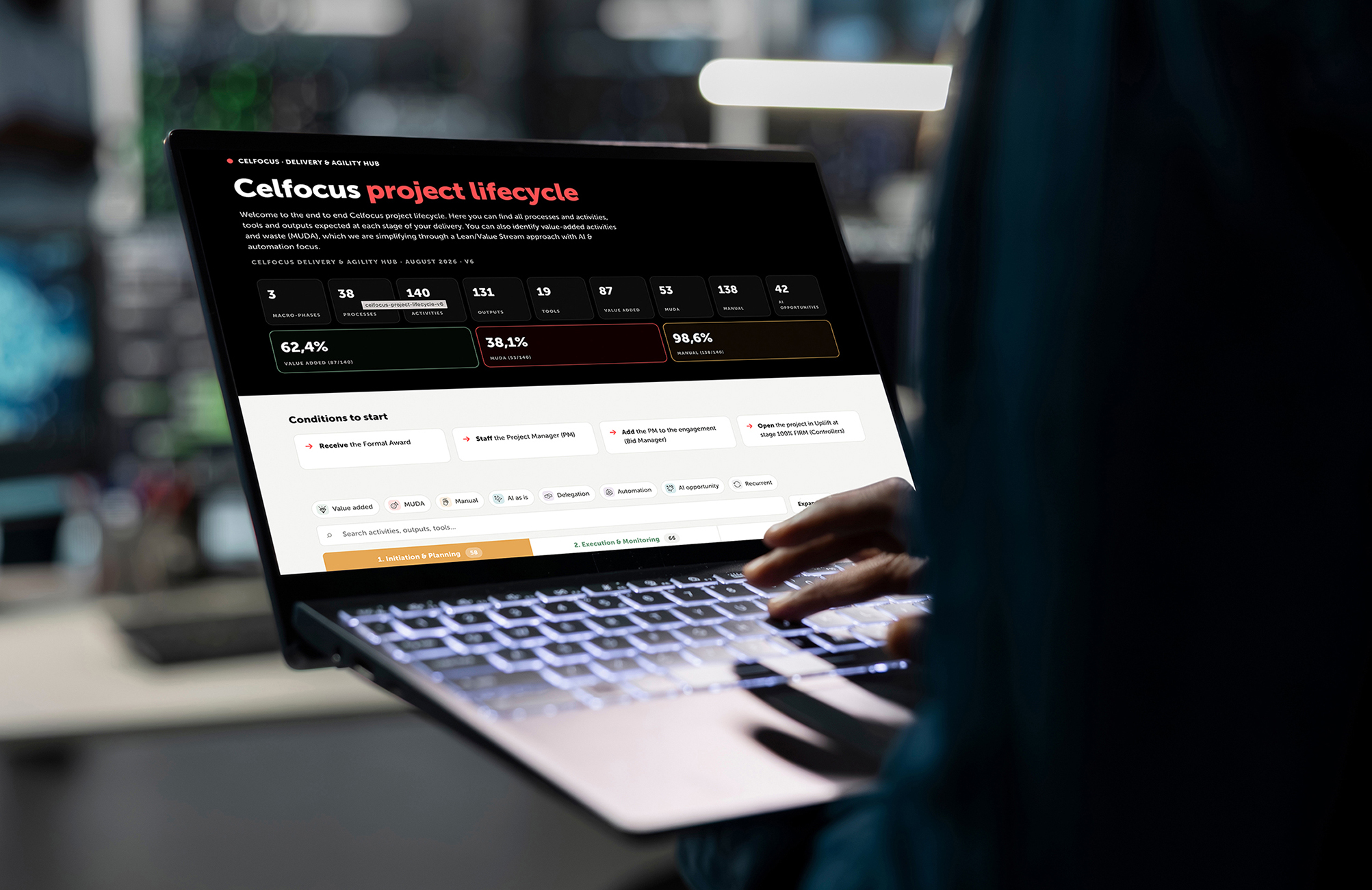
We are now turning these ideas into concrete practices, processes, data, tools and experiments across our delivery lifecycle. This work sits naturally within the Delivery & Agility Hub, but in the lens of collective knowledge and collaboration, we want to invite you to participate and contribute, just reach out!

This is only the introduction. Over the coming weeks, we will start sharing more within the Celfocus community and go deeper into the different dimensions of AI-Native Delivery: from hybrid team orchestration and delivery observability to agent architecture, FinOps, governance, human-in-the-loop and the skills that will define the next generation of delivery roles.

Welcome to the transformation!

This article is brought to you by Margarida Silva, the Delivery & Agility Hub Director.

No items found.

AI is changing how work gets done, but how are we redesigning the way we deliver projects and services? At Celfocus, this is the question behind AI-Native Delivery, the main transformation of our delivery model, led by the Delivery & Agility Hub.

Towards an Agentic Delivery Model

No items found.

Besides, we are exploring an agentic delivery architecture: a coordinated set of specialized agents embedded across the lifecycle, capable of supporting activities such as planning, analysis, governance, knowledge retrieval and delivery execution.

Remember that AI-native does not mean human-out. It means becoming much more deliberate about where human judgement creates value. Human-in-the-loop mechanisms, clear decision boundaries, and traceability will be essential. But so will something equally important: creating space to experiment safely.

We will not design the future of delivery perfectly on the first attempt. Teams need room to test, learn and adjust, with appropriate guardrails, contained risk and fast feedback.

There is something very familiar here. Agility has always been about reducing the cost of learning: shorter feedback loops, experimentation, transparency, and adapting based on evidence. AI changes the technology, but this principle remains the same. And we want to expand it within Celfocus culture.

Scaling Delivery

This transformation also requires us to simplify and connect the delivery lifecycle. Centralizing the right processes, data and tooling is therefore not an administrative exercise on the side. It is part of the architecture of AI-native delivery to also contribute to an enhanced delivery experience for leads and teams.

Every hour we recover from manual reporting, reconciliation and fragmented tooling is an hour we can redirect towards decisions, clients, teams and outcomes. From productivity small steps to big delivery outcomes. The value of AI cannot stop at individual productivity, it will reach scale at every future project.

That is where AI-native delivery becomes an operating model rather than a collection of practices and tools.

No items found.

AI is changing how work gets done, but how are we redesigning the way we deliver projects and services? At Celfocus, this is the question behind AI-Native Delivery, the main transformation of our delivery model, led by the Delivery & Agility Hub.

AI-Native Delivery

This is not simply about adding AI tools to existing processes. AI-augmented delivery can make individual activities faster or even small team setups more adequate. But AI-native delivery goes further: it asks us to rethink the entire lifecycle. What we manage, what we measure, where decisions take place, how teams operate, and which activities still add value.

The ambition is a leaner delivery flow: less bureaucracy, better visibility, faster decisions, increased quality, and stronger focus on business outcomes. Sounds like Nirvana, but it is possible in the near future.

What Changes?

Project and Service Managers will increasingly operate in environments where teams are hybrid, combining people, AI agents and automated capabilities. Managing these teams will require new skills: understanding what to delegate, what to supervise, where human judgement is essential, and how accountability works across human and machine contributions. Oh and review everything, always!

Observability will also become part of everyday delivery management in near real time. We need to understand flow, quality, cost, risk and outcomes continuously, rather than reconstructing them afterwards through reports and status meetings. In a faster world, projects cannot rely on old methods of monitoring.

As agents become part of project architecture, new questions emerge. What can an agent access? What decisions can it make? How does it interact with other agents and systems? How is its output validated? Who remains accountable? And how do we ensure security, compliance and traceability?

These are no longer purely technology questions. They are delivery questions.

The same applies to cost. AI introduces new resources to manage: models, tokens, licenses, compute and increasingly complex consumption patterns (and sometimes hidden costs). FinOps principles will therefore become more relevant to delivery teams too, helping us understand not only whether a solution works, but whether its economics make sense at scale. No surprises.

Building the Foundations

AI-native delivery only works if the foundations are there, and we are already working on some of them. Building a governed and trusted delivery data foundation, creating consistent definitions, structured data and the data quality required to establish a reliable source of truth across our projects and services.

In parallel, we are redesigning our delivery lifecycle end to end, including processes, activities, controls and decision gates, templates, outputs and tools. Then identify which signals can be captured automatically and observed and which activities to remove to create space for the future Delivery.

From there, the ambition becomes much more interesting: conversational delivery dashboards that allow teams and leaders to prompt delivery information directly, understand what is changing and why, identify risks and trends, and move from static reporting towards genuine decision support. Nowadays some of these capabilities are already available on Delivery AI Agent DEX. Have you already tried it?

Towards an Agentic Delivery Model

No items found.

Besides, we are exploring an agentic delivery architecture: a coordinated set of specialized agents embedded across the lifecycle, capable of supporting activities such as planning, analysis, governance, knowledge retrieval and delivery execution.

Remember that AI-native does not mean human-out. It means becoming much more deliberate about where human judgement creates value. Human-in-the-loop mechanisms, clear decision boundaries, and traceability will be essential. But so will something equally important: creating space to experiment safely.

We will not design the future of delivery perfectly on the first attempt. Teams need room to test, learn and adjust, with appropriate guardrails, contained risk and fast feedback.

There is something very familiar here. Agility has always been about reducing the cost of learning: shorter feedback loops, experimentation, transparency, and adapting based on evidence. AI changes the technology, but this principle remains the same. And we want to expand it within Celfocus culture.

Scaling Delivery

This transformation also requires us to simplify and connect the delivery lifecycle. Centralizing the right processes, data and tooling is therefore not an administrative exercise on the side. It is part of the architecture of AI-native delivery to also contribute to an enhanced delivery experience for leads and teams.

Every hour we recover from manual reporting, reconciliation and fragmented tooling is an hour we can redirect towards decisions, clients, teams and outcomes. From productivity small steps to big delivery outcomes. The value of AI cannot stop at individual productivity, it will reach scale at every future project.

That is where AI-native delivery becomes an operating model rather than a collection of practices and tools.

From Vision to Reality

We are now turning these ideas into concrete practices, processes, data, tools and experiments across our delivery lifecycle. This work sits naturally within the Delivery & Agility Hub, but in the lens of collective knowledge and collaboration, we want to invite you to participate and contribute, just reach out!

This is only the introduction. Over the coming weeks, we will start sharing more within the Celfocus community and go deeper into the different dimensions of AI-Native Delivery: from hybrid team orchestration and delivery observability to agent architecture, FinOps, governance, human-in-the-loop and the skills that will define the next generation of delivery roles.

Welcome to the transformation!

This article is brought to you by Margarida Silva, the Delivery & Agility Hub Director.

No items found.
Go Back
More
Call to Collaboration
Let Us Know Your Thoughts About Our Newsletter!
Start by
Saying Hi!
© 2026 Celfocus. All rights reserved.
Let Us Know Your Thoughts About Our Newsletter!
Start by
Saying Hi!
© 2026 Celfocus. All rights reserved.
60
80
the-ai-productivity-journey
40
speak-up-and-act-quickly
45
just-landed
43
claude-code-vs-github-copilot
50
growing-together
55
catching-up
90
from-pilot-to-platform
60
ai-native-delivery
96
celfocus-awards-2026
99
open-door
95
on-the-menu
100
side-by-side
98
interview