More
CALL to Start

Cloud computing has already transformed the way businesses build, deploy, and scale technology. Not long ago, simply moving workloads to the cloud felt revolutionary. Innovations such as virtual machines, elastic storage, and payasyougo pricing reshaped the industry at an unprecedented pace.
Today, however, we are witnessing an even more profound shift. Artificial intelligence has moved from being an optional addon to becoming the central intelligence behind modern cloud platforms. When cloud technology converges with AI, it opens a new frontier of expertise, one that is not only more powerful, but fundamentally different.
AIdriven cloud platforms are not just faster or cheaper versions of traditional systems. They think, predict, and adapt. They analyze massive volumes of data in real time, anticipate demand before it spikes, detect threats before they cause damage, and even resolve issues autonomously. The cloud has moved beyond infrastructure and now acts as an intelligent partner.
In today’s landscape, cloud professionals are expected to understand far more than infrastructure configuration. Skills now extend into machine learning concepts, data pipelines, automation strategies, and AIdriven decisionmaking.
At its core, an AIdriven cloud platform is one where intelligence is deeply embedded into infrastructure, services, and operations. This goes beyond offering machine learning APIs. The platform itself uses AI to continuously optimize performance, security, cost, and reliability.
Automation marked a key milestone, with Infrastructure as Code, CI/CD, and DevOps reducing manual effort and improving consistency. Now, AI-driven cloud platforms go further, learning from data and context to support and sometimes outperform human decision-making.
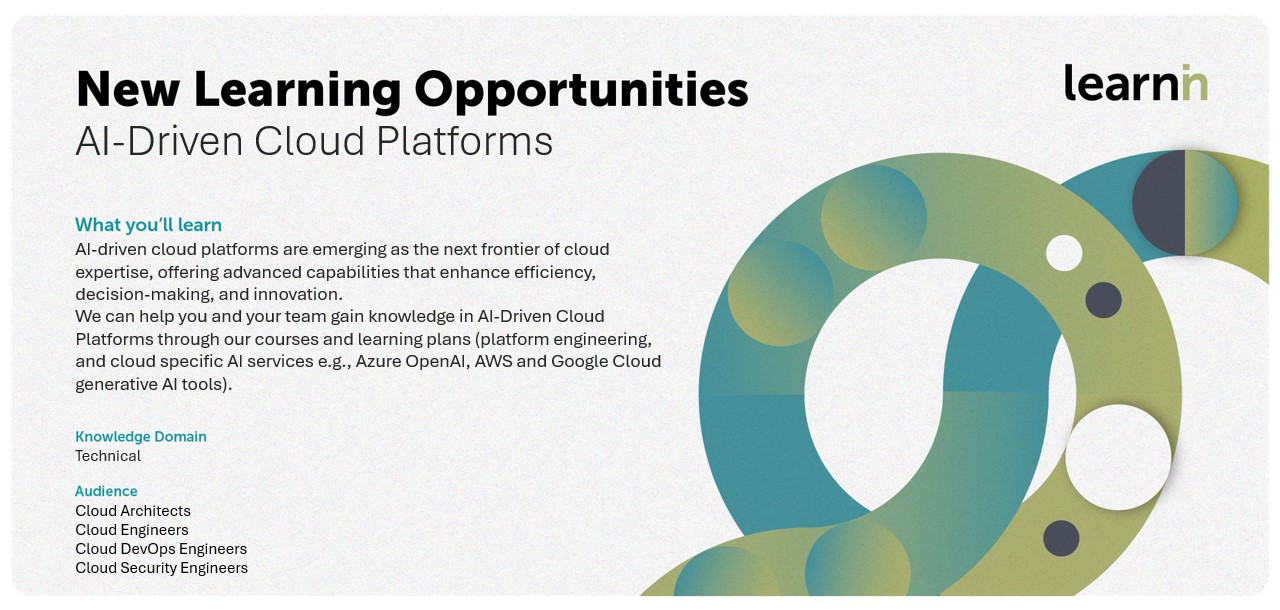
Traditional cloud skills focused on configuration and maintenance: provisioning instances, balancing loads, and troubleshooting failures. These skills remain important, but they are no longer sufficient on their own.
Modern cloud expertise requires understanding how intelligent systems behave, how data flows through platforms, and how AIdriven decisions are made and governed.
Celfocus training supports this shift with practical learning paths in generative AI, AI-assisted operations, platform engineering, and cloud AI services (Azure OpenAI, AWS, Google Cloud), enabling professionals to confidently design, secure, optimize, and scale intelligent cloud environments.
.jpg)
A. An AI-driven cloud platform embeds intelligence into the planning, build and operate phases of cloud environments. In the planning phase, AI is a great tool to break down complex workflows, detail ways to improve the solution and to brainstorm new ideas while respecting the best practices of Cloud Infrastructures. In the build phase, Generative AI accelerates Infrastructure as Code (IaC), supports Terraform development, simplifies cross-cloud refactoring, and assists with Kubernetes and container integrations. Engineers move from writing everything manually to collaborating with AI to design and refine infrastructure faster.
In the operations phase, AI analyzes logs, metrics, and cost data to detect anomalies, support FinOps, and assist with troubleshooting. With structured context access (e.g., MCP), AI systems can evolve from rule-based automation to context-aware recommendations and controlled remediation.
Traditional automation executes predefined rules, while AI-driven platforms introduce adaptive intelligence, contextual awareness, and data-driven decision support.
A. AI enables cloud engineers to borrow cloud architect skills by acting more like supervisors of intelligent systems when working in the cloud. Instead of focusing only on manual configuration and deployment, engineers increasingly collaborate with AI tools that can generate infrastructure code, analyze operational data, and propose optimizations. In this context, their role shifts toward guiding, validating, and governing AI-assisted outputs.
To operate effectively in this new model, several core capabilities become essential. One of the most important is AI collaboration and prompt engineering, which involves structuring clear, context-rich prompts and carefully validating AI-generated outputs. At the same time, engineers must maintain strong Infrastructure-as-Code (IaC) and architecture fundamentals, including a solid understanding of Terraform and cloud services, so they can properly review, refine, and approve AI suggestions.
Another important capability is AIOps literacy, which allows engineers to interpret AI-driven anomaly detection, cost insights, and operational recommendations. In addition, agent integration and governance skills are becoming increasingly relevant, particularly when designing secure guardrails for AI agents that interact with cloud APIs and platforms.
Looking ahead, cloud deployments may also include solution-aware AI agents embedded directly into the architecture. By integrating agents through Model Context Protocol (MCP) servers, these agents can securely access relevant system context—such as Kubernetes clusters, logs, cost data, and configurations—and assist with tasks including real-time troubleshooting, automated diagnostics, FinOps optimization recommendations, configuration validation, and controlled remediation workflows.
This evolution significantly increases the strategic value that cloud engineers bring. Rather than only delivering infrastructure, they increasingly deliver intelligent cloud platforms that continuously optimize and support themselves.
A. Organizations adopting AI in their cloud environments face several important challenges that require careful management. One of the main risks is over-reliance on AI, which can gradually lead to erosion of technical skills or allow configuration errors to go unnoticed. To mitigate this, organizations should maintain strong engineering practices such as code reviews, well-defined architecture standards, and validation pipelines that ensure AI-generated outputs are properly verified.
Another challenge is the possibility of incorrect or incomplete AI outputs. Large language models can produce responses that appear technically sound but contain inaccurate configurations or assumptions. This risk can be reduced by providing AI systems with structured and well-scoped context, enforcing policy-as-code frameworks, and rigorously testing all generated configurations before deployment.
Security and data exposure is also a significant concern. When AI systems process operational logs, cost data, or infrastructure information, organizations must ensure that sensitive data is properly protected and that compliance requirements are met. Mitigation typically involves using enterprise-grade AI platforms, applying strict identity and access management controls, maintaining comprehensive audit logging, and clearly defining permissions for any AI agents interacting with cloud APIs.
Cultural and organizational adoption can present challenges. Teams may initially struggle to trust AI recommendations or to integrate AI-driven workflows into existing governance models. A practical approach is to begin with advisory or assistive AI use cases and gradually expand toward controlled automation, always supported by clear governance frameworks and operational guardrails.
Finally, AI-driven cloud platforms represent a shift from static automation to intelligent, context-aware systems. The future is not just AI-assisted engineering, but cloud solutions enhanced with embedded, solution-aware agents — amplifying both operational resilience and engineering impact.
This article is brought to you by Esmeralda Monteiro, Celfocus Training Manager.
Cloud computing has already transformed the way businesses build, deploy, and scale technology. Not long ago, simply moving workloads to the cloud felt revolutionary. Innovations such as virtual machines, elastic storage, and payasyougo pricing reshaped the industry at an unprecedented pace.
Today, however, we are witnessing an even more profound shift. Artificial intelligence has moved from being an optional addon to becoming the central intelligence behind modern cloud platforms. When cloud technology converges with AI, it opens a new frontier of expertise, one that is not only more powerful, but fundamentally different.
AIdriven cloud platforms are not just faster or cheaper versions of traditional systems. They think, predict, and adapt. They analyze massive volumes of data in real time, anticipate demand before it spikes, detect threats before they cause damage, and even resolve issues autonomously. The cloud has moved beyond infrastructure and now acts as an intelligent partner.
In today’s landscape, cloud professionals are expected to understand far more than infrastructure configuration. Skills now extend into machine learning concepts, data pipelines, automation strategies, and AIdriven decisionmaking.
At its core, an AIdriven cloud platform is one where intelligence is deeply embedded into infrastructure, services, and operations. This goes beyond offering machine learning APIs. The platform itself uses AI to continuously optimize performance, security, cost, and reliability.
Automation marked a key milestone, with Infrastructure as Code, CI/CD, and DevOps reducing manual effort and improving consistency. Now, AI-driven cloud platforms go further, learning from data and context to support and sometimes outperform human decision-making.
Traditional cloud skills focused on configuration and maintenance: provisioning instances, balancing loads, and troubleshooting failures. These skills remain important, but they are no longer sufficient on their own.
Modern cloud expertise requires understanding how intelligent systems behave, how data flows through platforms, and how AIdriven decisions are made and governed.
Celfocus training supports this shift with practical learning paths in generative AI, AI-assisted operations, platform engineering, and cloud AI services (Azure OpenAI, AWS, Google Cloud), enabling professionals to confidently design, secure, optimize, and scale intelligent cloud environments.
A. An AI-driven cloud platform embeds intelligence into the planning, build and operate phases of cloud environments. In the planning phase, AI is a great tool to break down complex workflows, detail ways to improve the solution and to brainstorm new ideas while respecting the best practices of Cloud Infrastructures. In the build phase, Generative AI accelerates Infrastructure as Code (IaC), supports Terraform development, simplifies cross-cloud refactoring, and assists with Kubernetes and container integrations. Engineers move from writing everything manually to collaborating with AI to design and refine infrastructure faster.
In the operations phase, AI analyzes logs, metrics, and cost data to detect anomalies, support FinOps, and assist with troubleshooting. With structured context access (e.g., MCP), AI systems can evolve from rule-based automation to context-aware recommendations and controlled remediation.
Traditional automation executes predefined rules, while AI-driven platforms introduce adaptive intelligence, contextual awareness, and data-driven decision support.
A. AI enables cloud engineers to borrow cloud architect skills by acting more like supervisors of intelligent systems when working in the cloud. Instead of focusing only on manual configuration and deployment, engineers increasingly collaborate with AI tools that can generate infrastructure code, analyze operational data, and propose optimizations. In this context, their role shifts toward guiding, validating, and governing AI-assisted outputs.
To operate effectively in this new model, several core capabilities become essential. One of the most important is AI collaboration and prompt engineering, which involves structuring clear, context-rich prompts and carefully validating AI-generated outputs. At the same time, engineers must maintain strong Infrastructure-as-Code (IaC) and architecture fundamentals, including a solid understanding of Terraform and cloud services, so they can properly review, refine, and approve AI suggestions.
Another important capability is AIOps literacy, which allows engineers to interpret AI-driven anomaly detection, cost insights, and operational recommendations. In addition, agent integration and governance skills are becoming increasingly relevant, particularly when designing secure guardrails for AI agents that interact with cloud APIs and platforms.
Looking ahead, cloud deployments may also include solution-aware AI agents embedded directly into the architecture. By integrating agents through Model Context Protocol (MCP) servers, these agents can securely access relevant system context—such as Kubernetes clusters, logs, cost data, and configurations—and assist with tasks including real-time troubleshooting, automated diagnostics, FinOps optimization recommendations, configuration validation, and controlled remediation workflows.
This evolution significantly increases the strategic value that cloud engineers bring. Rather than only delivering infrastructure, they increasingly deliver intelligent cloud platforms that continuously optimize and support themselves.
A. Organizations adopting AI in their cloud environments face several important challenges that require careful management. One of the main risks is over-reliance on AI, which can gradually lead to erosion of technical skills or allow configuration errors to go unnoticed. To mitigate this, organizations should maintain strong engineering practices such as code reviews, well-defined architecture standards, and validation pipelines that ensure AI-generated outputs are properly verified.
Another challenge is the possibility of incorrect or incomplete AI outputs. Large language models can produce responses that appear technically sound but contain inaccurate configurations or assumptions. This risk can be reduced by providing AI systems with structured and well-scoped context, enforcing policy-as-code frameworks, and rigorously testing all generated configurations before deployment.
Security and data exposure is also a significant concern. When AI systems process operational logs, cost data, or infrastructure information, organizations must ensure that sensitive data is properly protected and that compliance requirements are met. Mitigation typically involves using enterprise-grade AI platforms, applying strict identity and access management controls, maintaining comprehensive audit logging, and clearly defining permissions for any AI agents interacting with cloud APIs.
Cultural and organizational adoption can present challenges. Teams may initially struggle to trust AI recommendations or to integrate AI-driven workflows into existing governance models. A practical approach is to begin with advisory or assistive AI use cases and gradually expand toward controlled automation, always supported by clear governance frameworks and operational guardrails.
Finally, AI-driven cloud platforms represent a shift from static automation to intelligent, context-aware systems. The future is not just AI-assisted engineering, but cloud solutions enhanced with embedded, solution-aware agents — amplifying both operational resilience and engineering impact.
This article is brought to you by Esmeralda Monteiro, Celfocus Training Manager.
Cloud computing has already transformed the way businesses build, deploy, and scale technology. Not long ago, simply moving workloads to the cloud felt revolutionary. Innovations such as virtual machines, elastic storage, and payasyougo pricing reshaped the industry at an unprecedented pace.
Today, however, we are witnessing an even more profound shift. Artificial intelligence has moved from being an optional addon to becoming the central intelligence behind modern cloud platforms. When cloud technology converges with AI, it opens a new frontier of expertise, one that is not only more powerful, but fundamentally different.
AIdriven cloud platforms are not just faster or cheaper versions of traditional systems. They think, predict, and adapt. They analyze massive volumes of data in real time, anticipate demand before it spikes, detect threats before they cause damage, and even resolve issues autonomously. The cloud has moved beyond infrastructure and now acts as an intelligent partner.
In today’s landscape, cloud professionals are expected to understand far more than infrastructure configuration. Skills now extend into machine learning concepts, data pipelines, automation strategies, and AIdriven decisionmaking.
At its core, an AIdriven cloud platform is one where intelligence is deeply embedded into infrastructure, services, and operations. This goes beyond offering machine learning APIs. The platform itself uses AI to continuously optimize performance, security, cost, and reliability.
Automation marked a key milestone, with Infrastructure as Code, CI/CD, and DevOps reducing manual effort and improving consistency. Now, AI-driven cloud platforms go further, learning from data and context to support and sometimes outperform human decision-making.
Traditional cloud skills focused on configuration and maintenance: provisioning instances, balancing loads, and troubleshooting failures. These skills remain important, but they are no longer sufficient on their own.
Modern cloud expertise requires understanding how intelligent systems behave, how data flows through platforms, and how AIdriven decisions are made and governed.
Celfocus training supports this shift with practical learning paths in generative AI, AI-assisted operations, platform engineering, and cloud AI services (Azure OpenAI, AWS, Google Cloud), enabling professionals to confidently design, secure, optimize, and scale intelligent cloud environments.
A. An AI-driven cloud platform embeds intelligence into the planning, build and operate phases of cloud environments. In the planning phase, AI is a great tool to break down complex workflows, detail ways to improve the solution and to brainstorm new ideas while respecting the best practices of Cloud Infrastructures. In the build phase, Generative AI accelerates Infrastructure as Code (IaC), supports Terraform development, simplifies cross-cloud refactoring, and assists with Kubernetes and container integrations. Engineers move from writing everything manually to collaborating with AI to design and refine infrastructure faster.
In the operations phase, AI analyzes logs, metrics, and cost data to detect anomalies, support FinOps, and assist with troubleshooting. With structured context access (e.g., MCP), AI systems can evolve from rule-based automation to context-aware recommendations and controlled remediation.
Traditional automation executes predefined rules, while AI-driven platforms introduce adaptive intelligence, contextual awareness, and data-driven decision support.
A. AI enables cloud engineers to borrow cloud architect skills by acting more like supervisors of intelligent systems when working in the cloud. Instead of focusing only on manual configuration and deployment, engineers increasingly collaborate with AI tools that can generate infrastructure code, analyze operational data, and propose optimizations. In this context, their role shifts toward guiding, validating, and governing AI-assisted outputs.
To operate effectively in this new model, several core capabilities become essential. One of the most important is AI collaboration and prompt engineering, which involves structuring clear, context-rich prompts and carefully validating AI-generated outputs. At the same time, engineers must maintain strong Infrastructure-as-Code (IaC) and architecture fundamentals, including a solid understanding of Terraform and cloud services, so they can properly review, refine, and approve AI suggestions.
Another important capability is AIOps literacy, which allows engineers to interpret AI-driven anomaly detection, cost insights, and operational recommendations. In addition, agent integration and governance skills are becoming increasingly relevant, particularly when designing secure guardrails for AI agents that interact with cloud APIs and platforms.
Looking ahead, cloud deployments may also include solution-aware AI agents embedded directly into the architecture. By integrating agents through Model Context Protocol (MCP) servers, these agents can securely access relevant system context—such as Kubernetes clusters, logs, cost data, and configurations—and assist with tasks including real-time troubleshooting, automated diagnostics, FinOps optimization recommendations, configuration validation, and controlled remediation workflows.
This evolution significantly increases the strategic value that cloud engineers bring. Rather than only delivering infrastructure, they increasingly deliver intelligent cloud platforms that continuously optimize and support themselves.
A. Organizations adopting AI in their cloud environments face several important challenges that require careful management. One of the main risks is over-reliance on AI, which can gradually lead to erosion of technical skills or allow configuration errors to go unnoticed. To mitigate this, organizations should maintain strong engineering practices such as code reviews, well-defined architecture standards, and validation pipelines that ensure AI-generated outputs are properly verified.
Another challenge is the possibility of incorrect or incomplete AI outputs. Large language models can produce responses that appear technically sound but contain inaccurate configurations or assumptions. This risk can be reduced by providing AI systems with structured and well-scoped context, enforcing policy-as-code frameworks, and rigorously testing all generated configurations before deployment.
Security and data exposure is also a significant concern. When AI systems process operational logs, cost data, or infrastructure information, organizations must ensure that sensitive data is properly protected and that compliance requirements are met. Mitigation typically involves using enterprise-grade AI platforms, applying strict identity and access management controls, maintaining comprehensive audit logging, and clearly defining permissions for any AI agents interacting with cloud APIs.
Cultural and organizational adoption can present challenges. Teams may initially struggle to trust AI recommendations or to integrate AI-driven workflows into existing governance models. A practical approach is to begin with advisory or assistive AI use cases and gradually expand toward controlled automation, always supported by clear governance frameworks and operational guardrails.
Finally, AI-driven cloud platforms represent a shift from static automation to intelligent, context-aware systems. The future is not just AI-assisted engineering, but cloud solutions enhanced with embedded, solution-aware agents — amplifying both operational resilience and engineering impact.
This article is brought to you by Esmeralda Monteiro, Celfocus Training Manager.
.png)